
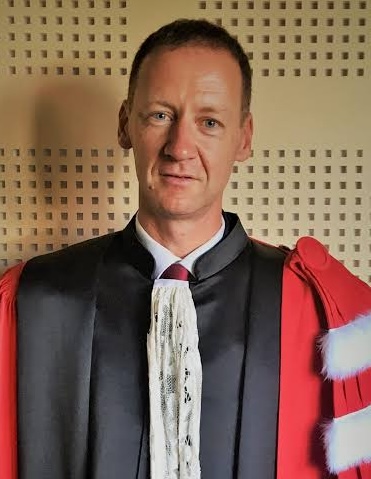
Petr Muzny, an attorney admitted to the Paris and the Bern bar associations, has pleaded twice before the Grand Chamber of the European Court of Human Rights—most notably in Bayatyan v. Armenia (2011), the landmark judgment recognizing the right to conscientious objection to military service under Article 9 of the European Convention on Human Rights. He is also full professor of public law at the University of Savoie Mont Blanc and professor of law at the University of Geneva. This post is based on his presentation at the ICLRS 33rd Annual International Law and Religion Symposium, held at Brigham Young University, 4–6 October 2026.
Should the right of conscientious objection to military service also be recognized during wartime? The answer is yes. More than any other fundamental right, the right of conscientious objection to military service would have no substance if it were not recognized during wartime because the objection of conscience is a specific reaction to violence whose ultimate expression is war. A right that dissolves at the precise moment its object appears is not a right.
Maintaining that right in wartime (I) has historical, legal, and practical justifications and (II) is possible without compromising national security.
I. Justifications of the conscientious objectors’ protection during wartime
Recognition has always been a wartime measure
The assertion that conscientious objection is a peacetime luxury is historically false. Nearly every foundational recognition was granted by a state at war, or on the eve of war, and short of men.
In 1575, amid the Dutch Revolt, William the Silent allowed Mennonites to buy exemption from military service. During the US Civil War, the Confederate Exemption Act of October 1862 exempted Quakers, Mennonites, Dunkards, and Nazarenes, upon payment of a tax (section VI); in February 1864 the Union Congress guaranteed non-combatant assignment to members of religious bodies whose articles of faith forbade bearing arms (section 17).
The modern institution dates from 1916. Facing catastrophic attrition, Britain introduced conscription through the Military Service Act and, with it, a conscience clause open to any conscript on his own account rather than to designated sects (section 2(1)(d)). Local tribunals adjudicated individual claims of conscience while the Battle of the Somme was being fought; more than 16,000 objectors passed through them, against roughly five million men who served. The state’s treatment of absolutists was brutal, but the machinery worked, and it was built in the worst year of the war.
In 1940, section 5(g) of the US Selective Training and Service Act completed the movement, exempting any person who, by reason of religious training and belief, was conscientiously opposed to participation in war in any form. Recognition ceased to depend on membership and came to rest on the individual’s own conviction.
International recognitions follow the same pattern. Yoon & Choi v. Republic of Korea (2006) concerned a state that remains legally at war under an armistice and has pleaded the necessity of maintaining universal conscription due to threats from the DPRK; the UN Human Rights Committee (CCPR or Committee) found a violation of International Covenant on Civil and Political Rights (ICCPR) Article 18 regardless. Bayatyan v. Armenia (2011) concerned a state with no peace treaty and a heavily militarized “line of contact” separating Armenian and Azerbaijani forces. Mushfig Mammadov & Others v. Azerbaijan (2019) was the mirror image across the same frozen conflict. Beginning in the late 1990s, a line of cases arose from Turkey’s internal 40-year armed conflict over Kurdish autonomy.[1] Kanatlı v. Türkiye(2024) concerned Northern Cyprus, which has essentially been under Turkish military administration since 1974.
The right is non-derogable, and that settles the legal question
ICCPR Article 18 is excluded from suspension by Article 4(2), even in a public emergency threatening the life of the nation.[2] In Article 4(2), the drafters listed non-derogable rights—that is, rights that could not be suspended during wartime—and freedom of conscience was deliberately included. A right whose wartime content is narrower than its peacetime content is not non-derogable in any meaningful sense, which is why the Committee has criticized states that confine recognition to peacetime (see, e.g., para. 14).
Since Atasoy & Sarkut v. Turkey (2012), the CCPR has located the right to conscientious objection in the forum internumelement of Article 18(1) rather than the forum externum or manifestation limb. The limitations in Article 18(3) therefore do not engage at all, and there is no proportionality exercise into which consideration of national security can be fed.
By contrast, European Convention on Human Rights (ECHR) Article 9 is derogable under ECHR Article 15, as Ukraine’s 28 February 2022 notification to the Council of Europe demonstrated, before Ukraine withdrew Article 9 from the scope of that derogation on 4 April 2024.[3] But the gap closes from within Article 15 itself. Article 15(1) permits only measures strictly required by the exigencies of a situation and not inconsistent with a state’s other obligations under international law. A derogation producing a result forbidden by the non-derogable ICCPR Article 18 is therefore ultra vires Article 15 itself. Nor, absent derogation, is national security even an available ground: it does not figure among the limitations permitted by Article 9(2), an omission the European Court of Human Rights (ECtHR) has held to be deliberate.[4]
The Venice Commission reached a compatible conclusion in its amicus curiae brief to the Constitutional Court of Ukraine: the very nature of conscientious objection means it cannot be fully excluded in time of war, and under no circumstances may an objector be obliged to bear or use arms, even in self-defense of the country (paras. 52, 60–61).
No army has ever been disorganized by objectors
The practical case rests on evidence rather than apprehension. Objectors are a negligible fraction of any mobilization base: 16,000 against five million in Britain, a few hundred a year in Korea against some 300,000 conscripts. Wherever the floodgates fear has been tested, it has failed.
Nor does exemption favor the enemy. The genuine objector refuses service as such, not context-specific service “in this army against that one.” Jehovah’s Witnesses, the most numerous objectors of the twentieth century, were beheaded in Germany and jailed in Britain and the United States for one and the same refusal—a contradiction noted in the House of Lords in 1943, when a British White Paper condemning Hitler for imprisoning them was read against Britain’s own tribunals. A man who will not fight for either belligerent takes nothing from the balance between them.
II. How to recognize conscientious objection during wartime without compromising national security
State authorities invoke two obstacles to permitting conscientious objection: (A) that genuineness cannot be determined, opening the door to mass draft evasion, and (B) that exempting an objector while other soldiers risk their lives offends equality. Both challenges can be resolved in ways that serve the military as much as the objector.
How to identify a genuine and sincere conscientious objector
Sincerity can be assessed on two complementary levels: belonging, evidenced by baptism and congregational records and by adherence documented before the call-up; and personal conviction, evidenced by the applicant’s own account of how their conviction was formed, corroborated by acquaintances, school records, and the pattern of the applicant’s life. Convictions formed or adopted in adulthood call for the same two-level assessment, with closer scrutiny of when and how they arose. As evidence of feasibility, rather than a model: Korea’s review commission shows such determinations to be workable even under an armistice, its scrutiny extending even to an applicant’s taste for violent video games.[5]
The decisive point is that screening is not a concession extracted from the military but an instrument the military needs. Without a procedure, independent of the military and impartial, the army cannot distinguish the believer from the evader and must treat both as criminals.[6] With a procedure, it identifies the evader precisely and with the cooperation of the religious communities, which have every interest in seeing false claimants excluded. A state cannot maintain both that sincerity is undiscoverable and that its courts are competent to convict men for insincerity, which is what a prosecution for draft evasion asserts.
How to reconcile exemption with the equality owed to those who fight
Equality is not mathematical, and objectors are not to be compared only with those who fight. They must be compared with everyone whom the state lawfully spares. Ukraine illustrates this plainly: reservations exist for employees of critical enterprises, for IT and energy workers, and for academics—and, since December 2024, all clerics of registered religious organizations can receive exemptions from mobilization, with no requirement of any conviction against bearing arms and no alternative service imposed. The ordinary believer, whose conviction is identical, receives no exemption. Yet the Strasbourg Court has held that confining alternative service to clergy and students of religious seminaries empties the right of much of its substance. The Venice Commission makes the same point as a matter of proportionality: in assessing whether refusal of alternative service under mobilization is necessary, it is relevant to consider what other exemptions the government has granted and their scope.
Those who limit or selectively grant the right also misdescribe who objectors are. Objectors are individuals prepared to serve either outside the military (alternativists) or within it unarmed (noncombatants), in medical support, reconstruction, demining logistics, or care of the displaced. Each one so assigned releases another man for mobilization. Recognition thus adds to the manpower pool rather than subtracting from it, provided the service is genuinely civilian in its command structure, as stipulated by the ECtHR in Adyan & Others v. Armenia (2017) and Teliatnikov v. Lithuania (2022), and free of the punitive duration condemned by the CCPR in Foin v. France (1999), Maille v. France (2000), and Venier & Nicolas v. France (2000).
The benefits run both ways. The objector keeps their liberty and their conscience and is permitted to contribute rather than rot. The state gains a worker instead of a prisoner, spares the expense of prosecution and detention, removes from its units an individual who would in any event not fire, forecloses the adverse judgments that inevitably follow, and denies the adversary the propaganda of a state that jails its own believers.
Conclusion
Neither of the obstacles invoked by states—determining genuineness and offending equality—has legal or practical foundation. What remains is political: the pressure that grieving, frightened, and justly angry public opinion exerts on legislators who must explain, often in distorted terms, why one young person stays home while another is buried. That pressure is real and deserves respect rather than dismissal.
But public pressure is not a legal category, and no state has yet explained why it can do less than Britain managed in the year of the Somme. Nothing in the emotional weight of public opinion justifies what is done with it: the imprisonment of individuals whose only offense is that they will not kill and whose convictions, in the end, are almost invariably quashed.
References:
[1] Erçep v. Turkey, App. No. 43965/04 (ECtHR 22 Nov. 2011); Savda v. Turkey, App. No. 42730/05 (ECtHR 12 June 2012); Tarhan v. Turkey, App. No. 9078/06 (ECtHR 17 July 2012); see also Ülke v. Turkey, App. No. 39437/98, para. 62 (ECtHR 24 Jan. 2006) (discussing the “civil death” resulting from repeated prosecution).
[2] UN Human Rights Committee, General Comment No. 22, UN Doc. CCPR/C/21/Rev. 1/Add. 4, §§ 1, 11 (1993); General Comment No. 29, UN Doc. CCPR/C/21/Rev. 1/Add. 11, § 7 (2001).
[3] It should be noted that, unlike several other constitutional rights that have been subject to temporary restrictions under martial law, such as freedom of movement, Ukraine has not adopted any constitutional derogation or additional limitation concerning freedom of religion or belief. The constitutional protection of FoRB has formally remained intact.
[4] Nolan & K. v. Russia, App. No. 2512/04, para. 73 (ECtHR 12 Feb. 2009); Christian Religious Organization of Jehovah’s Witnesses in the NKR v. Armenia, App. No. 41817/10, para. 78 (ECtHR 22 Mar. 2022).
[5] See Constitutional Court, 2011Hun-Ba379, 28 June 2018 (S. Kor.) (finding unconstitutional the absence of alternative service); Supreme Court, 2016Do10912, 1 Nov. 2018 (S. Kor.) (en banc); Act on Assignment to and Performance of Alternative Service, Act No. 16851, 31 Dec. 2019 (S. Kor.).
[6] See Papavasilakis v. Greece, App. No. 66899/14, paras. 54–66 (ECtHR 15 Sept. 2016).