
The Politics of Metanoia: Conscience, Community, and the Conditions of Human Flourishing

Alexis de La Ferrière is a lecturer of sociology at Royal Holloway, University of London.

Human flourishing depends on the interplay of individuation and communion—on the capacity of persons to develop as individual moral agents while doing so through relationships and shared forms of life. A well-ordered society must therefore protect both the freedom of the person and the associational ecology in which persons are formed, collaborate with others, and pursue shared goods. Religious freedom is particularly important in this respect. It protects not only individual conscience but also the institutions, communities, and collective practices through which persons may encounter and inhabit accounts of the good that are inherited or discovered, independent of the state.

A society concerned with these conditions of flourishing must resist both political indifference and political overreach. It cannot simply leave persons to pursue their preferences within a thin framework of non-interference, because flourishing depends on the social and associational conditions in which persons develop. But neither can public authority determine in advance the form flourishing should take. The ultimate fulfillment of the human person lies beyond politics: it belongs to religion and eschatological hope, however one conceives of these, not to the administrative functions of the state. The state or any other coercive authority cannot manufacture transformative flourishing, and any attempt to do so risks reducing inward transformation to external conformity. The proper task of politics is more limited but no less important: to secure the individual and associational conditions in which persons remain capable of genuine transformation.

(more…)

Continue ReadingThe Politics of Metanoia: Conscience, Community, and the Conditions of Human Flourishing

Magnifica Humanitas: Human Dignity, Technology, and the International Order

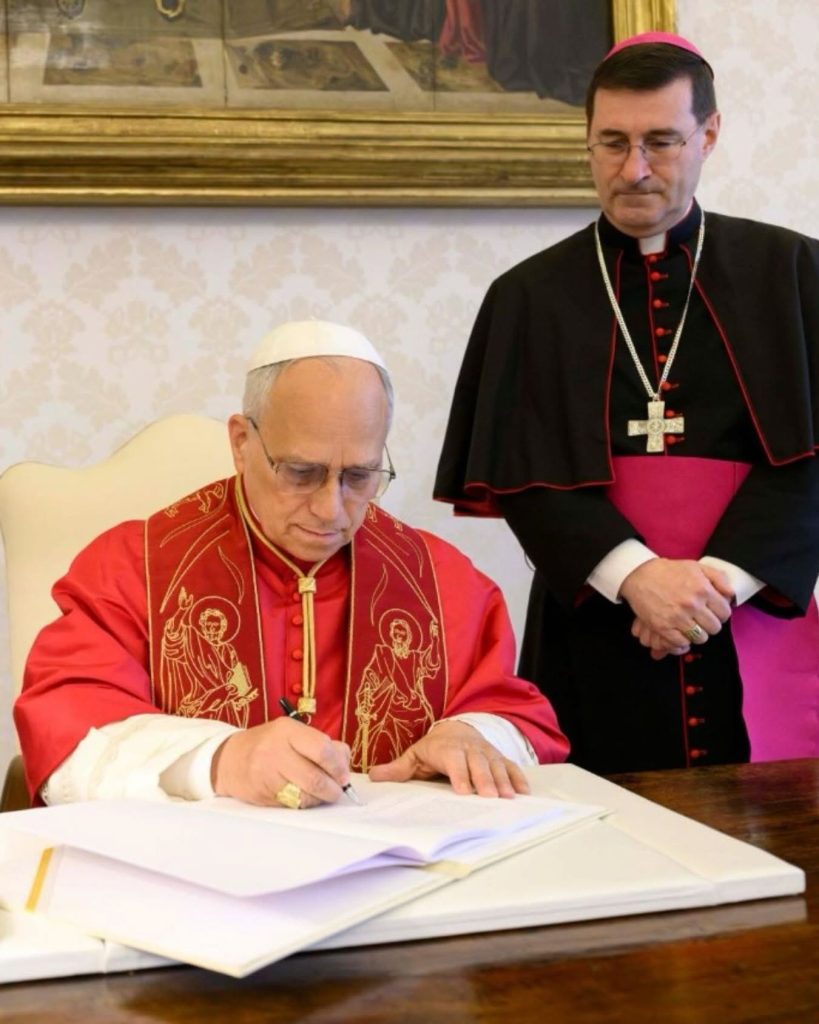
Pope Leo XIV signing the Magnifica Humanitas Encyclical / Vatican News

In May 2025, Pope Leo XIV presented his first encyclical letter, Magnifica Humanitas. In a lengthy, thoughtfully constructed, insightful document, the Pope addresses a broad range of questions from the nature of human personality to artificial intelligence to peaceful international order. It emphasizes the role of human dignity as an ultimate ethical principle for navigating the challenges and leveraging the opportunities that our rapidly changing world holds for humanity. It warns against both unlimited belief in technological progress and Luddism-style rejection of it. This blog series has united theologians, constitutional theorists, political scholars, software business managers, and human rights lawyers to reflect on this powerful document and on the ethical approaches and solutions it advocates to make our use of technology safer and more dignified, and the world more just, equal, and peaceful.

(more…)

Continue ReadingMagnifica Humanitas: Human Dignity, Technology, and the International Order

Strengthening the Interpretation and Implementation of UN Resolution 55/17, Human Rights and a Culture of Peace

Brett G. Scharffs is director of the International Center for Law and Religion Studies and Rex E. Lee Chair and Professor of Law at the J. Reuben Clark Law School, Brigham Young University. The following is a lightly edited version of his remarks given during a panel discussion on Human Rights Council Resolution 55/17, Human Rights and a Culture of Peace, during the 61st Session of the UN Human Rights Council, 4 March 2026, at the Assembly Hall, Palais de Nations, Geneva, Switzerland.

I would like to join others in thanking the High Commissioner for Human Rights for organizing this panel discussion on Human Rights Council Resolution 55/17, Human Rights and a Culture of Peace, adopted two years ago, on 4 April 2024.

(more…)

Continue ReadingStrengthening the Interpretation and Implementation of UN Resolution 55/17, Human Rights and a Culture of Peace