
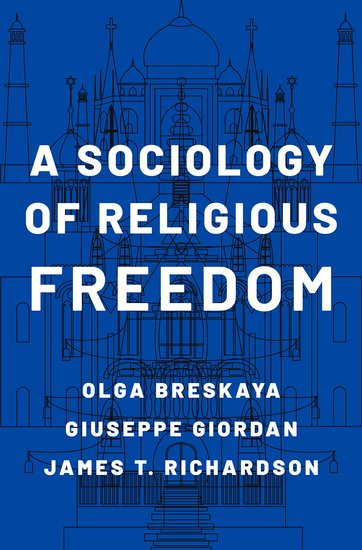
In this series, coauthors Olga Breskaya, Giuseppe Giordan, and James T. Richardson provide insights from their 2025 monograph A Sociology of Religious Freedom. They define religious freedom as a multidimensional concept, located at the intersection of five areas of meaning: (a) the autonomy of individuals and religious groups, (b) the societal value of freedom of and from religion, (c) the normative principles of state-religion governance, (d) international human rights standards, and (e) the socio-legal impacts of the judicialization of religion. The combination of social and legal perspectives enriches both sociologists and lawyers with a better understanding of how religious freedom operates in a time of secularization and pluralization of Western societies.
Giordan’s post sets up the theory of religious freedom and explains the aims of sociological studies of this human right. Borrowing from legal sociology, Richardson’s post focuses on the judicialization of religious freedom and the roles of American and European courts in shaping its scope and limits. Breskaya’s contribution discusses empirical methods of investigating religious freedom.
Posts of the series:
Giuseppe Giordan. Three Aims of Sociology of Religious Freedom: Toward a New Paradigm of Religious Change
James T. Richardson. Religious Freedom and the Courts
Olga Breskaya. Measuring Religious Freedom in Perceptions