

Brandon Reece Taylorian is a research fellow at the University of Lancashire (UK).
Introduction
Caribbean states have inherited—and reshaped—colonial approaches to governing religion. Since gaining independence, governments across the region have had to decide what it means to be “secular,” which communities the state treats as legitimate, and what legal steps religious groups must take to operate in public life. Those choices matter for freedom of religion or belief (FoRB) because recognition and registration rules shape who can manifest their beliefs and how, for example, by building places of worship or providing pastoral care in public institutions like hospitals, prisons, and the military.
International standards offer a clear baseline. Article 18 of the International Covenant on Civil and Political Rights (ICCPR) protects FoRB, including the right to manifest religion or belief “in worship, observance, practice and teaching.” In the Americas, Article 12 of the American Convention on Human Rights similarly protects freedom of conscience and religion. Registration regimes can be compatible with these commitments when they facilitate ordinary legal needs—purchasing and owning property, hiring staff, opening bank accounts, receiving donations, and securing tax or customs exemptions—without turning legal personality into a permit to exist or to conduct basic activities.
Across the Caribbean, several recognition and registration systems are formally optional (communities can exist and worship without registering), while a minority treats registration as mandatory by law or by practice. Yet “optional” does not automatically mean FoRB–friendly: unequal recognition, administrative bureaucracies, and disproportionate information demands often fall hardest on minority, especially non-Christian, communities including Hindus, Muslims, Rastafarians, as well as practitioners of African-rooted folk beliefs like Obeah, Myalism, Santería, Vodou, and Yoruba.
Secularity and State Recognition
Most Caribbean constitutions describe their states as secular (see Figure 1), yet many also invoke God, or the upholding of “Christian values” in preambles or oaths of allegiance. Secularity is not itself the problem; the FoRB concern is whether the state treats religious communities equally and neutrally in law and practice.
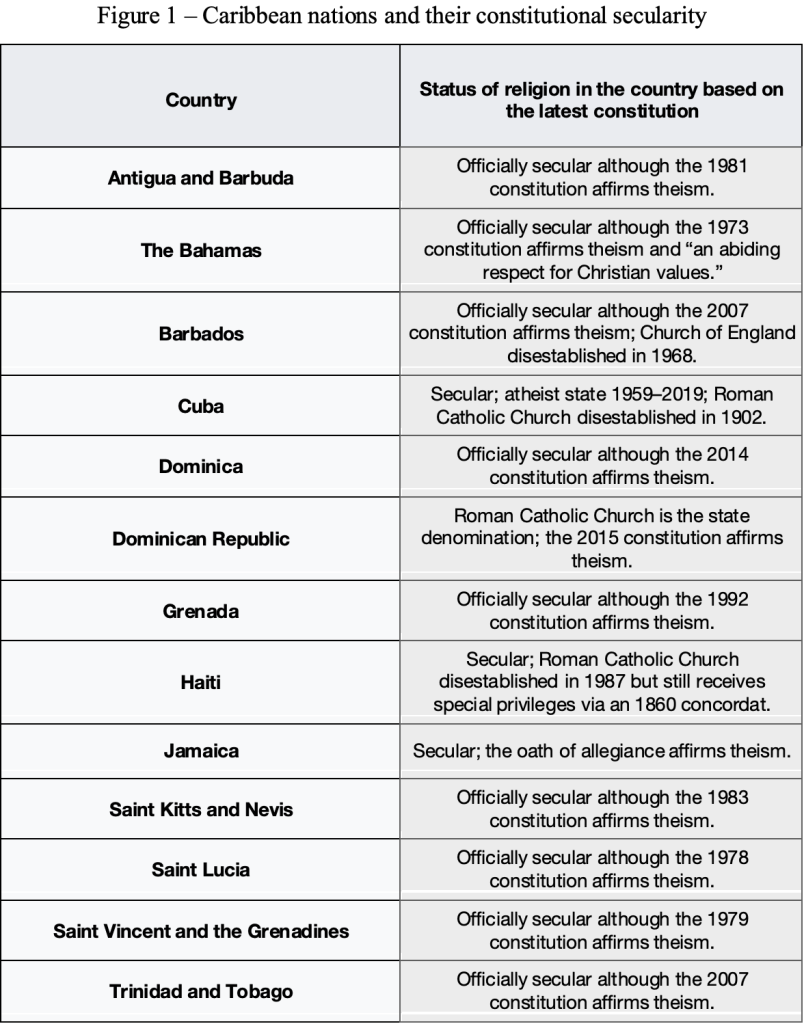
The clearest case of formal privilege is the Dominican Republic, where a 1954 concordat with the Holy See has long given the Roman Catholic Church a distinctive legal position and establishes it as the state denomination. Beyond symbolism, that status has been associated with practical advantages, including easier access to some benefits and a structured relationship with state institutions that other communities must work harder to secure. Although FoRB standards do not prohibit a state from favoring a religion unless doing so results in discrimination, nor do they prohibit multilayered registration systems where one tradition receives “recognition” by default, minority communities begin from an unequal baseline under such systems that puts them at a practical disadvantage.
A softer form of privilege appears where consultation structures are built around a narrow set of denominations. Christian council models in Antigua and Barbuda and The Bahamas provide regular access and influence for participating churches, while newer Christian movements and non-Christian communities may find engagement with government more ad hoc. These arrangements may be defended as pragmatic dialogue mechanisms, but they can unintentionally create a closed forum for familiar denominations.
Recognition problems also arise in legal categorization. Six Caribbean states (Cuba, the Dominican Republic, Jamaica, Saint Kitts and Nevis, Saint Lucia, and The Bahamas) do not provide a distinct legal form for religious or belief organizations, directing communities into generic nonprofit, NGO, or company/corporate law statuses. This matters because religious organizations are not merely service providers: they represent communities of faith or belief with distinctive needs (e.g., ministry, community identity, and pastoral care). Treating them as generic associations can force faith communities to retrofit their structures to corporate templates not designed for religious life. Conversely, Saint Vincent and the Grenadines has a law that allows religious groups to register as “nonprofit religious institutions” which acknowledges the religious nature of the organization’s activities as distinct from secular nonprofits.
Lingering criminal prohibitions show how recognition can be undermined even where states claim neutrality. In several jurisdictions (Antigua and Barbuda, Dominica, Jamaica, Saint Vincent and the Grenadines, and The Bahamas), Afro-Caribbean folk practices such as Obeah remain formally criminalized while colonial-era laws in Jamaica also criminalize Myalism. Even if enforcement is sporadic, keeping bans on the statute books deters religious practice and preserves the legal possibility of selective enforcement against stigmatized communities. If governments are concerned about fraud, coercion, or intimidation sometimes committed under the label of “Obeah,” the less restrictive route is to enforce ordinary criminal law against specific misconduct of involved individuals or groups rather than criminalizing an entire belief system or practice.
Unreasonably lengthy administrative delays can also undercut state claims of neutrality and nondiscrimination. Trinidad and Tobago has weaponized registration against the Orisha folk religion by not responding to their application for legal personality since 2018, preventing the group from receiving tax-exempt donations, performing marriages, or receiving visas for foreign missionaries.
Spectrum of Religious Registration: Identifying When Registration Becomes Effectively Mandatory
FoRB guidance from international and regional bodies has repeatedly warned against mandatory registration, especially where unregistered activity attracts sanctions or where essential religious functions like hosting worship services or proselytizing depend on legal personality. Because existing literature lacked nuance regarding different types of registration policies and unclear definitions of “mandatory registration,” my doctoral research aimed to develop tools to better understand the registration of religious groups. One output from that research was the Spectrum of Religious Registration, which has been adapted in Figure 2 to show where Caribbean states fit, revealing that registration takes different forms in the region.
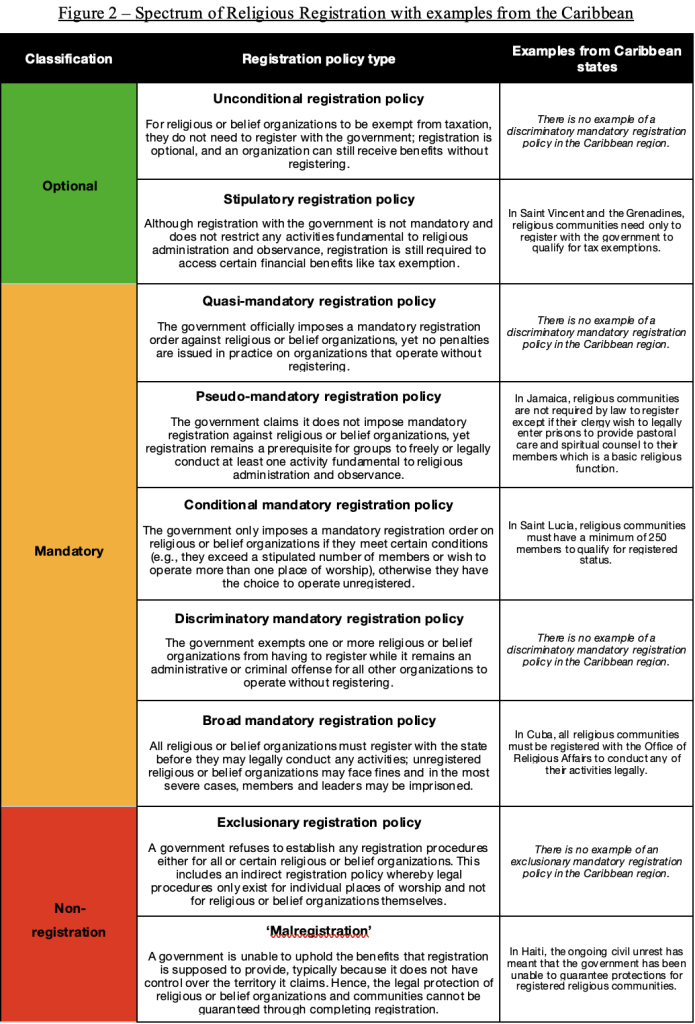
At the most restricted end are systems where registration is a precondition for lawful religious operation and penalties attach to non-registration. Cuba is the region’s clearest example. Under such a system, religious organizations are expected to obtain state approval before operating, and unregistered activity can trigger fines, confiscation, or closure. Even registration does not guarantee autonomy: communities may need permission for activities the state treats as outside “regular services,” a category authorities interpret broadly.
Other Caribbean states describe registration as optional but structure key activities so that, in practice, communities must register to function normally. The Bahamas is often categorized as such a state because legal personality is necessary for groups to “use any form of income to promote religion” and to hold land in the organization’s name for constructing or maintaining worship premises. Jamaica illustrates a similar “pseudo-mandatory” dynamic: communities can exist without formal registration, but certain ministry functions—especially access to prisons for pastoral care—depend on registered status. Where registration becomes the gateway to routine religious administration, “optional” can operate as “compulsory in effect.”
Saint Lucia illustrates a further variant: conditional access to registration. There, operating without registering is legal if the group has fewer than 250 members, but once the group passes this threshold the government mandates registration. However, groups seeking registration also cannot register without first passing the 250-member threshold. Where eligibility depends on a membership threshold, smaller communities and newer movements can be excluded from legal personality and the benefits linked to it. If the ability to conduct civilly significant rites (notably marriages) depends on registered status, membership thresholds operate as a structural restriction on religious practice and community viability.
Elsewhere, in Grenada, religious groups can operate without registering, but the state does require registration to qualify for customs and tax exemptions. On the spectrum illustrated in Figure 2, Grenada corresponds with “stipulatory” registration policy.
Registration Inequality: Onerousness, Oversight, and Unequal Access to Benefits
Even where registration is available, procedures can be onerous in ways that undermine FoRB. Three questions help identify when burdens become problematic: Can diverse groups qualify? (accessibility), Are groups treated consistently and fairly? (equitability), and Do promised benefits materialize without new restrictions? (visibility).
The Dominican Republic illustrates how burdens can compound through layered procedures. Registration may require extensive documentation to secure legal personality and access certain concessions, and further recognition can be needed for clergy to perform legally recognized marriages. Additional conditions—such as time-in-country requirements—can delay equality with established communities. The result in the Dominican Republic is a two-track system: the Roman Catholic Church benefits by historic status, while others must navigate multiple steps, fees, and discretionary decisions to reach comparable practical standing.
Cuba shows how “visibility” can collapse into surveillance. Registration applications require detailed information on locations, leaders, and funding. State attention extends to religious meetings in private homes, with rules that may restrict where such gatherings take place, demand extensive reporting, and give authorities wide discretion to suspend meetings or close premises. When legal status is coupled with strict monitoring, registration becomes a mechanism of oversight rather than merely a pathway to fiscal benefits. Delayed or unanswered applications can then function as a quiet means of exclusion.
Haiti highlights a different challenge: even where the state does not actively seek to restrict religion, insecurity can prevent registration from delivering protection in practice (highlighting an example of “malregistration” on the spectrum criteria of Figure 2). When violence and instability restrict movement and reduce the state’s capacity to provide basic security, registered status may offer little practical assurance. Under these conditions, some religious communities, including Sunni and Shia Muslim groups, avoid registration to reduce exposure to oversight or political pressure, even if registration would otherwise help with property ownership or fiscal benefits. Vodou leaders argue that the decentralized nature of their community means they do not easily fit into the government’s registration system for religious institutions, which tends to emphasize a hierarchical leadership structure.
Conclusion
Across the Caribbean, recognition and registration laws reveal a recurring tension. States want to formalize religious groups into clear legal entities for property, taxation, and accountability purposes, but some systems drift into preference (privileging former state denominations), exclusion (through thresholds and delays), or control (through intrusive information demands and surveillance). A FoRB–compliant approach is straightforward in principle:
- registration should be optional;
- procedures should be clear, quick, inexpensive, and open to small and new communities;
- information requests should be limited to what is strictly necessary, avoiding details like meeting times and places that enable surveillance;
- decisions should be reasoned and appealable; and
- legal frameworks should recognize the distinctive nature of religious organizations rather than forcing them into ill-fitting secular categories.
Moving toward these ideals would make registration a tool that enables FoRB rather than a mechanism that quietly limits it.
There are, however, encouraging signs in the region. Some countries (Grenada and Dominica) keep registration primarily connected to tax and customs concessions and property benefits, while leaving worship and basic community life free from state permission requirements. Reforms in places such as Saint Kitts and Nevis—especially measures associated with Rastafarian rights recognition—show that law can be adapted to the realities of decentralized communities rather than forcing every tradition into a single corporate template.