
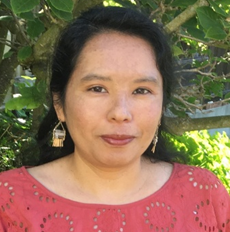
Cecilia Titizano is core faculty at NAITTS, an Indigenous learning community, and directs the Latina/o Theology and Ministry Leadership Network and the Instituto Hispano of the Jesuit School of Theology of Santa Clara University. This post is based on a presentation given at the ICLRS 32nd Annual International Law and Religion Symposium, 6 October 2025.
The post is the part of the Religious Freedom and Indigenous Rights series
Andean Metaphysics: The Interdependence of All Things
In the Andes, everything is alive: plants, animals, water, and even mountains. They are all animated by the same Ajayu or Spirit and share the same organizing and pulsing life force. They all have awareness (each in their own way); they allcommunicate (each in their own fashion); and they all are endowed with a purpose particular to their place in Pacha (all that is). The Aymara and Quechua people describe reality or “what is” as an interconnected web of beings endowed with the same animating life force, where relations constitute beingness or, better yet, becoming (beingness in process). Pacha (all that is) is dynamic and ontologically relational, where relations have priority over substance. Hence, the interdependence of all beings is a constitutive reality of the Andean universe.
As Indigenous communities across Abya Yala, or Latin America, advance their struggles for self-determination and secure environmental laws that protect waters, forests, and mountains, they are exposing the limitations of the Western legal human rights framework when applied to Indigenous realities and ethics. This occurs even where countries have adopted a Rights of Nature or “Mother Earth” (Derechos de Pachamama) as part of their constitution (Ecuador 2008) or have recognized the importance of protecting Pachamama through legislation rather than constitutional rights (Bolivia 2010, 2012). Other significant cases are (1) the Atrato River, which was granted legal personhood by Colombia’s Constitutional Court and acknowledged as a subject of rights, reflecting Afro-Colombian and Indigenous understandings of rivers as living entities (Colombia 2016); and (2) the recognition of the Marañón River as a subject of rights, which was upheld on appeal by Superior Court of Loreto rulings, not Peru’s Constitutional Court (Peru 2024).
I grew up surrounded by hills; they were our protectors, our old relatives or Apus with whom we have a relationship of mutual care. Individual rights emerge from a substance ontology where an entity or an individual has rights. In the Bolivian Andes, beingness evolves out of right relationships among beings or jaqi, an Aymara word that applies to all members of creation, animate and inanimate alike. There is no term for humans as entities distinct from the rest of creation. The emphasis is not on the essence or nature of being but the way a jaqi interacts with their relatives. Hence, we have kin with responsibilities toward one another. A river can be a jaqi if it relates and maintains right relationship or balance that promotes Suma Qamaña/Suma Kausay (good living), the fullness of life and beingness through reciprocal and harmonic relations.
Human rights law presumes autonomous subjects asserting claims against others, marked by an individual-centric, adversarial grammar. The primary concern here is squeezing (if not ignoring) Indigenous metaphysics that describe a relational world, full of beings, into a Western “rights-of-nature” schema, which often preserves the same substantive, individualizing ontology instead of centering duty, reciprocity, and balance. In addition, rights-of-nature statutes usually achieve protection by declaring rivers/forests/territories “legal persons,” borrowing a corporate fiction. That device is legible to courts but risks collapsing living, multirelational persons into a Western juridical persona whose voice is mediated by state-appointed guardians and litigation standing. Leading analyses warn that this legal personality route can reproduce anthropocentricity (who speaks for the river? under which state forum?) and flatten Indigenous kinship into a representational proxy, rather than sustaining ongoing covenantal relations with place.
Besides a few and far between cases, theologians have, for the most part, mistrusted and feared Indigenous spiritual traditions and very often treat them with contempt. With this historical background, the Post-Synodal Apostolic Exhortation letter, Querida Amazonia (2020), is a gift to the Catholic Church. In it, Pope Francis invites all to drink from Indigenous millennial wisdom, opening the door to Indigenous relational ontologies. The earth is a mother who bleeds due to multinationals that cut her veins. The Amazon becomes a place of revelation. The Indigenous voices cited inQuerida Amazonia remind me of Leni, a young Peruvian Amazonian leader from the Awajún-Wampis people, who offered a closer encounter with Indigenous cosmologies when, during a conflict with the Peruvian government, he declared, “We speak of our brothers who quench our thirst, who bathe us, those who protect our needs—this [brother] is what we call the river. We do not use the river for our sewage; a brother cannot stab another brother. We do not stab our brothers.”[1]
Recognizing a Pluriverse of Ontologies: Challenging the Coloniality of the Real
What Leni and many other Indigenous relatives describe are not religious beliefs and are without legal bearing in a modern and/or postmodern society. Returning to the Andes, mountains and hills are considered other-than-human people. Marisol de la Cadenas tell us that they are called tirakunas (earth beings), and they are as real as you, me, and Leni’s brother, the river. Once we overcome the nature-culture divide that separates human beings from the “natural world,” new ontologies begin to emerge. These new realities challenge what I have called “the coloniality of the real,” which has erased or silenced other ontologies that exist on the outskirts of Euro-modernity from contemporary political conversations. They move us beyond cultural differences that assume a shared universal ontology to an ontological opening wherein multiple worlds emerge in a pluriverse of ontologies.
In a pluriverse, there is space for Aymara grandmothers’ teachings, when they tell us, “Don’t make the seed cry.” The Aymara word Jachaña refers to the act of crying from experiencing deep suffering or t’aqhisiña. To cause suffering is an immoral and unethical act that goes against the fabric of life and disrupts cosmic balance. In Aymara, there is no term to express the violation of a human right; instead, there are terms such as Chuymà ust’ayaña (to cause a moral offense) or Usuchjaña (to hurt, to wound, to cause injury), which affect the flow of existence. In the Aymara ontology, any jaqi, including humans and other-than-human people, can cry.
The Andean conception of personhood differs significantly from Catholic theological anthropology, which maintains that only humans are made in God’s image and likeness (Genesis 1:26). Some have put forth theological proposals that extend God’s likeness to mammals, especially hominids, that might possess certain hints of intellect and will, but not at the level of humans. In other words, only humans are images of God, while some animals might share God likeness. This is a theological development in the right direction but falls short of conversing with Indigenous ontologies.
In the article Who Is Your Neighbord I propose a Trinitarian pneumatology that takes seriously Andean metaphysics and suggest that creation is the first incarnation of a triune God, by and in the Holy Spirit. This theological framework accounts for the presence of the Holy Spirit in all creation and its creatures, endowing them with awareness (each in their own way) and capacity to relate and communicate (each in their own fashion). Simply put, all members of creation possess some level of intellect and will, transcending the current ontological divide that pervades most Christian theologies.
A Plurilegal Framework
The recognition of a pluriverse requires the opening to a plurilegal framework. A plurilegal framework describes a legal order in which multiple normative systems—state law, Indigenous customary law, and international law—coexist and interact within the same territory. Rather than reducing Indigenous legal traditions to “customs” to be tolerated or overridden, plurilegality recognizes them as legitimate sources of authority with equal standing. For example, in the field of water governance, Indigenous communities understand rivers as living relatives with reciprocal duties, while state law traditionally frames them as resources or property. When these perspectives converge, legal pluralism becomes plurilegality: a structured coexistence where each framework informs decision-making. As Lieselotte Viaene explains, “plurilegal water realities . . . imply the coexistence and interaction of different, often competing, legal orders, each with its own legitimacy and validity.”[2] Such frameworks do not merely tolerate Indigenous law but actively negotiate across worldviews, aiming for balance, justice, and mutual recognition, particularly in contexts where Indigenous peoples assert rights of nature and personhood for rivers, forests, and mountains.
Conclusion
Needless to say, Indigenous theologizing is an imperative endeavor as we continue to decolonize theological categories that subsist at the substratum of Western legal frameworks. The future and well-being of all relatives, humans and other-than-humans, are at stake.
References:
[1] Marisol de la Cadena, Uncommoning Nature: Stories from the Anthropo-Not-Seen, in ANTHROPOS AND THE MATERIAL 35, 36 (Penny Harvey, Christian Krohn-Hansen & Knut G. Nustad eds., 2019).
[2] Lieselotte Viaene, Indigenous Water Ontologies, Hydro-Development and the Human/More-Than-Human Right to Water: A Call for Critical Engagement with Plurilegal Water Realities, WATER 13, no. 12 (2021): 1660, 11.