

Fearghas O’Beara is a senior research fellow at the Centre for Religion, Human Values, and International Relations at Dublin City University and is head of the European Parliament Liaison Office in Ireland. This post is based on chapter 5 of his book The European Union and Religion: The Supranational Meets the Supernatural (Routledge 2026).
On 1 July 2026, Ireland took over from Cyprus the six-monthly rotating presidency of the Council of the European Union, convening and presiding over the governments of the 27 EU member states until the end of 2026. On 7 July, Irish Taoiseach (Prime Minister) Micheál Martin, presented his government’s legislative program to the plenary of the European Parliament in Strasbourg, France, under three broad themes indicative of the current challenges facing the Union in an increasingly volatile geo-political context: competitiveness, security, and values. Two days later Prime Minister Martin met at Government Buildings in Dublin to discuss this program with representatives of Europe’s main Christian churches.
After the meeting, Martin stated, “Our churches and faith communities play a unique role in European society—socially, culturally and spiritually.”
According to the churches present, “[t]opics discussed included social cohesion, shared European values, peacebuilding, competitiveness and sustainability, migration and asylum policies, the Multiannual Financial Framework, humanitarian and development cooperation and a credible, citizen-centred EU enlargement process.”
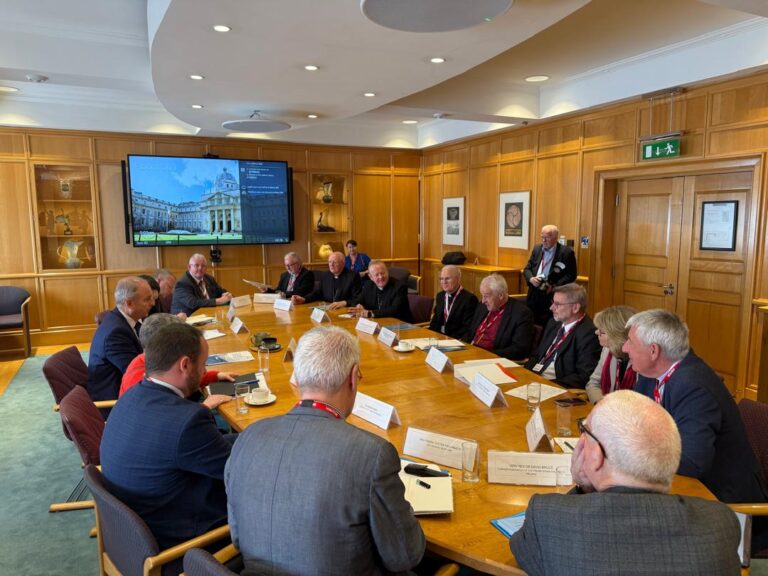
In the highly secularized European Union, including Ireland, statements such as these, and indeed the very holding of such a meeting, might appear to be something of an anachronism. It could be considered a breach of the strict “separation of church and state” that characterizes the constitutional arrangements of many EU states, though not all. However, in case this fraternizing between EU religious and political leaders might be considered an Irish anomaly, it is worth noting that a similar meeting took place in Nicosia six months earlier with the president and government of Cyprus as that country prepared to take over EU leadership.
Article 17: The EU Treaty’s Best-Kept Secret
Indeed, the leadership of the two Brussels-based organizations attending the Dublin meeting, which claim to jointly account for 90% of European religious believers, routinely travel to the capital of the EU member state assuming the bloc’s presidency, to meet with the government: COMECE, representing the Catholic Church in EU countries, and the Conference of European Churches (CEC), which brings together 115 churches from Orthodox, Protestant, and Anglican traditions across Europe. The purpose of these church-state meetings is not ecumenical or intercultural dialogue; it is to discuss the European Union’s legislative agenda for the half-year period. The legal basis for this dialogue is found in EU primary law, under Article 17 of the Treaty on the Functioning of the European Union (TFEU), which provides for open, transparent, and regular dialogue between EU institutions and European churches.
While this somewhat post-secular provision of the EU treaties may not be well known, the dialogue conducted by EU institutions is carried out transparently in accordance with treaty provisions. Churches and religious organizations, as well as philosophical and non-confessional organizations, engaging in the dialogue have signed up to the EU’s “Transparency Register”—a database listing “interest representatives” that carry out activities to influence EU policy and decision-making processes. Of more than 17,000 such interest groups in the register, a mere 58 have signed up in the section reserved for religious organizations. Nevertheless, a number of these—most notably COMECE and CEC—are very active in engaging with EU institutions across a range of policy areas through their Brussels-based representation offices staffed with lawyers and policy experts, not theologians and philosophers. While the Council presidency engages with them at the start of its six-month term, the two central “federal” EU institutions—the European Commission and Parliament—have more frequent, working-level consultations.
Religion, the EU, and Its Member States
From its modest beginnings with six founding states in 1957, the European Union of 2026 comprises 27 member states, with a further 10 seeking to join. Although politicians and parties representing Christian Democratic political thinking were particularly influential in most of the six founding countries in the post-war period, the club’s founding Treaty of Rome did not reference religion. Originally called the European Economic Community (EEC), the organization was the creation of its member states, designed to bring about economic and political integration to underpin the rebuilding of peace and prosperity in the western half of a continent divided by the Iron Curtain. So although many of the dreamers and designers of European integration were themselves committed Christians, religion was not considered relevant to the goals of the EEC, and indeed, church-state relations were a jealously guarded national competence.
However, as could be expected from the baked-in neo-functionalist elements in the design of European integration, the EU was not frozen in 1957 but continued to evolve in the direction of an “Ever Closer Union.” With each successive treaty revision—the bloc evolving from EEC to EC to EU—member states pooled their sovereignty in more and more policy areas and transferred more legislative powers to the central “federal” institutions of the European Commission and European Parliament. By the time the latest iteration—the Lisbon Treaty— entered into force in 2009, creating the first legal obligation on the Union with respect to religion, political-religious dialogue had already seeped into EU praxis, a development generally traced to then–Commission President Jacques Delors’s 1990 call for “a soul for Europe.”
Toward a Sui Generis Model of Religion-State Relations
Lacking a legal or political mandate to “do religion,” the EU’s executive branch, the Commission, had to edge into this territory deftly, conscious of the wide range of national approaches to “church-state” relations within the Union, ranging from state churches in the UK and Denmark to strict laïcité in France. Research on how the Commission achieved this feat, over the couple of decades before it had a solid legal basis on which to rely, has shown that a number of defining features of the EU approach gradually emerged. Taken together, these features describe an approach to religion-state relations that is clearly post-secular. But this approach is also sui generis, in that it takes account of a number of particularities of the EU, which is somewhere between an international organization and a state. These distinguishing features of the EU model could be synthesized thus:
- Subsidiarity: The EU leaves a margin of appreciation to individual member states, including in determining which churches they recognize, register, or grant public support to.
- Positive contribution: The EU views religious actors positively—as opposed to neutrally—and sees merit in engaging with them while shaping policy and legislation.
- Distinct from “civil society”: The EU treats religious organizations as having a character that sets them apart from other non-state actors in broader civil society.
- Church autonomy: The EU defers to religious organizations on matters of their own internal structures and is ready to grant exemptions in EU law on grounds related to religious identity.
- Confessional pluralism: While acknowledging its own religious and cultural hinterland, the EU is open to engaging with all churches and religious organizations.
- No strict separation: The EU engages pragmatically with religious actors, without taboos—for example, on religious symbols or language in public places or discourse—and without prohibition on partnering with religious organizations or funding their projects.
The qualitative research carried out for my book found that both the institutional and religious sides of the EU’s religion-state engagement shared a common perception of the ”shape” of the EU model, one that contains the above features. While differences of emphasis exist, often linked to institutional culture, there is general consensus that when the EU engages with religious organizations it does so in ways that are characteristic and consistent.
Since the entry into force of the Lisbon Treaty—and specifically Article 17 of the Treaty on the Functioning of the European Union—the EU model has been in a phase of codification. The two main EU institutions involved, the Commission and the Parliament, have each evolved their own rules, structures, and praxes to engage with religion. These include clear mandates for those coordinating the activities, guidelines for how the dialogues should be conducted, and transparency regarding the persons and organizations engaging with EU institutions and the policy content of discussions.
Ironically, the first attempt to codify the Commission’s engagement with churches and religious organizations was prompted by a ruling from the European Ombudsman in 2013, following a complaint by the European Humanist Federation in 2011. While the EU’s post-secular turn was initially met with stiff opposition by certain humanist groupings anxious for the EU to maintain a more separationist stance common to, say, French or Belgian traditions, much of this suspicion has subsequently dissipated.
It is clear that the EU’s own model of religion-state relations has taken shape in terms of the “rules of engagement” of the two sides, a model that draws from the different traditions of EU member states but is not constrained by these. Thus, it is a model that has the potential to evolve further, just as the EU itself continues to evolve as a polity. The European Union is in a process of both “deepening” and “widening”: it is developing deeper levels of integration in areas such as security and defense, while at the same time planning to expand by up to 10 new member states, mostly to its east. These developments will change the fundamental nature of the EU, so it might be expected that the nature of its religion-state relations will also change over time.