
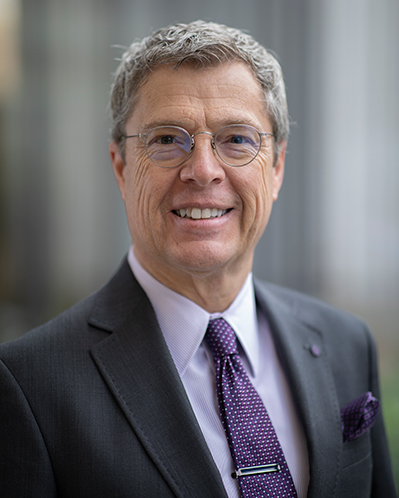
Brett G. Scharffs is director of the International Center for Law and Religion Studies and Rex E. Lee Chair and Professor of Law at the J. Reuben Clark Law School, Brigham Young University. The following is a lightly edited version of his remarks given during a panel discussion on Human Rights Council Resolution 55/17, Human Rights and a Culture of Peace, during the 61st Session of the UN Human Rights Council, 4 March 2026, at the Assembly Hall, Palais de Nations, Geneva, Switzerland.
I would like to join others in thanking the High Commissioner for Human Rights for organizing this panel discussion on Human Rights Council Resolution 55/17, Human Rights and a Culture of Peace, adopted two years ago, on 4 April 2024.
This was a remarkable achievement, not least because it was the result of a genuinely cross-regional effort that departed from earlier United Nations Declarations regarding the right to peace. Adopted by consensus at a time of deep political polarization, the Resolution on Human Rights and a Culture of Peace represents an accomplishment that deserves special attention, recognition, and commendation.
In my brief time, I would like to emphasize three observations that I hope will contribute to the shared “experiences, good practices, achievements, challenges and lessons learned concerning strategies for how protecting human rights contributes to promoting and strengthening a culture of peace” (A/HR/RES/55/17 16(a)).
1. Human Rights, a Culture of Peace, and Human Dignity for Everyone Everywhere
First, the Resolution on Human Rights and a Culture of Peace invites us to see the interrelationship between three important ideas that can be visualized as three points of a triangle, or three legs of a stool. Two of these are explicit in the Resolution, but one needs further elaboration.
The first point is human rights. The Resolution presciently notes that “peace and security, development and human rights are the pillars of the United Nations system and the foundations for collective security and well-being.” The Resolution expressly adopts a human rights–based approach to creating cultures of peace. Genuine peace, which the Resolution notes is more than the absence of conflict, requires the full realization of all human rights.
The second point of the triangle is the culture of peace that is the subject of the Resolution. Social scientists often remind us that culture lies downstream from law; laws, including the codification of human rights, will do us little good if we do not have cultures that support human rights and cultures that inculcate peace.
This leads to the third point of the triangle, or third leg of the stool, which is largely missing from the Resolution: human dignity. Human dignity, we have learned, is both the foundational principle of human rights (found in the first sentence of the Preamble and in Article 1 of the Universal Declaration of Human Rights) and the preeminent prerequisite to creating cultures of peace.
Our Center, the International Center for Law and Religion Studies, for nearly a decade has focused like a laser on the importance of human dignity, including in the development, drafting, and adoption of the Punta del Este Declaration on Human Dignity for Everyone Everywhere (2018). Similarly, the Beirut Declaration on “Faith for Rights” (2017) emphasizes the importance of all believers—whether theistic, nontheistic, atheistic, or other—to uphold human rights (and human dignity) for all people. If you add to this the Geneva Resolution 55/17 on Human Rights and a Culture of Peace, we have a thematic, as well as geographic, three-cornered mental map comprised of these integrally related concepts: human dignity (Punta del Este), human rights (Beirut), and a culture of peace (Geneva). I submit that we will fail to promote cultures of peace if we fail to focus on the two other corners of this triangle as well: human dignity and human rights.
Focusing on human dignity will also help us navigate the treacherous waters of frontier issues at the intersection of peace and human rights, such as the use of artificial intelligence for good. Human dignity is the most important metric for assessing applications of artificial intelligence: dignity-enhancing AI should be encouraged whereas dignity-degrading AI should be discouraged or even, in extreme cases, prohibited.
2. Engagement with Faith-Based Actors
My second observation relates to engagement with faith-based actors. Creating cultures of peace will be greatly enhanced, indeed in many places it will only be possible, if there is conscientious and purposeful engagement with religious voices—yes, religious leaders, but more broadly religious actors, including women and youth (groups the Resolution is cognizant of in other contexts). This is not quite a blind spot in the Resolution (it includes some discussion of involving “religious and linguistic minorities” in the promotion of a culture of peace), but the Resolution falls short in articulating the importance of engaging with religion in peacemaking or, more broadly, in inculcating a culture of peace. Returning to my previous point, nearly every religious tradition has important teachings about human dignity, human rights, and peacemaking. Ignoring religion, giving short shrift to this broad category of social life, or lumping it together with civil society writ large, will severely compromise efforts to create cultures of peace.
For example, Russell M. Nelson, who was president of The Church of Jesus Christ of Latter-day Saints from 2018 to 2025, when he passed away at the age of 101, spent the last few years of his ministry urging Church members, and all of us, to be peacemakers. In a General Conference address titled “Peacemakers Needed,” he distinguished between conflict (which is a natural feature of life) and contention (which is a chosen response to conflict). In that address, President Nelson said:
Contention drives away the Spirit—every time. Contention reinforces the false notion that confrontation is the way to resolve differences; but it never is. Contention is a choice. Peacemaking is a choice. You have your agency to choose contention or reconciliation. I urge you to choose to be a peacemaker, now and always.
President Nelson continued:
Brothers and sisters, we can literally change the world—one person and one interaction at a time. How? By modeling how to manage honest differences of opinion with mutual respect and dignified dialogue.
One recurring theme in President Nelson’s messages on becoming peacemakers is that “the transforming power of God’s love will change us and empower us to be peacemakers.”[1] From this unapologetically religious perspective, we are reminded that if we are to become peacemakers, the first change that must take place is within ourselves: We must allow ourselves to be transformed by God’s love.
Even if we view religion as a source of conflict (which undeniably it sometimes is), resolving those conflicts will often involve religious resources as well. In most cases, better religion will be an important part of the solution to violence or conflict perpetrated in the name of religion.
In addition, while Resolution 55/17 addresses the importance of education, it is silent on the topic of faith-based learning, both in formal and informal contexts. But religious education can be used both to inculcate extremist and peaceful understandings of religious texts. Orienting faith-based education around values of human dignity, human rights, and peacemaking is an essential strategy for creating cultures of peace (but one that is missing from Resolution 55/17).
A related point is that, in my experience, we do not need more interfaith dialogue; we need more multifaith engagement, a different paradigm, which is based on building rich relationships of trust with acknowledgment of differences, rather than focusing solely on high-level conversations about points of agreement.
3. Powerful People or Interests Who Do Not Want Peace
My third observation is perhaps the most sobering. It relates to the biggest obstacle to peace. When we speak about peacemaking, or creating a culture of peace, it is easy to speak in aspirational terms or in ways that are quite abstract and idealistic. But here is the hard truth: The most significant obstacle to peace is people or interests who do not want peace. When those people or interests are very powerful—for example, the leaders of nations or powerful economic actors—this is particularly problematic.
When we think of most of the seemingly intractable “hot” conflicts in the world today, on one side (and sometimes both) we will find a leader who is not interested in peace. They want something else—victory, territory, power, wealth, resources, the address of grievances, . . . . The list is long. For those of us who strive for peace, we often must begin by acknowledging that we are dealing with antagonists who are not interested in peace, and we need to try to find strategies for altering that equation, hopefully through persuasion, but in any event by altering their calculation of their own interests. This can be frightfully difficult. This is one reason why, for all its shortcomings, constitutional democracy and the rule of law are so important. “The people” need to have the opportunity to choose leaders who want peace, and when the people make a mistake, they need to have an opportunity to correct it.
When democracy is ruptured, a rupture in human rights and an erosion of human dignity will follow almost as an axiomatic consequence. Thus, a culture of peace will not be the only casualty of ruptured democracy: economic development, and especially the distribution of economic gains, will likely be disrupted as well, along with human rights and human dignity.
Conclusion
In conclusion, I have offered three observations. First, in addition to human rights and peacemaking, we need to focus on a third, related concept: human dignity for everyone everywhere. Second, we cannot ignore faith-based actors. And third, we must acknowledge that there are powerful leaders and interests who are not interested in peace, and we need to support mechanisms for changing their minds or changing those leaders.
My hope is that what we have learned about developing and strengthening cultures of peace can help strengthen the interpretation and implementation of Resolution 55/17.
Reference:
[1] As noted by President Camille N. Johnson, General Relief Society President of The Church of Jesus Christ of Latter-day Saints. Lenae Rubey, International Society Holds 34th Annual Conference, NEWSROOM, BYU DAVID M. KENNEDY CENTER FOR INTERNATIONAL STUDIES (24 April 2024).