
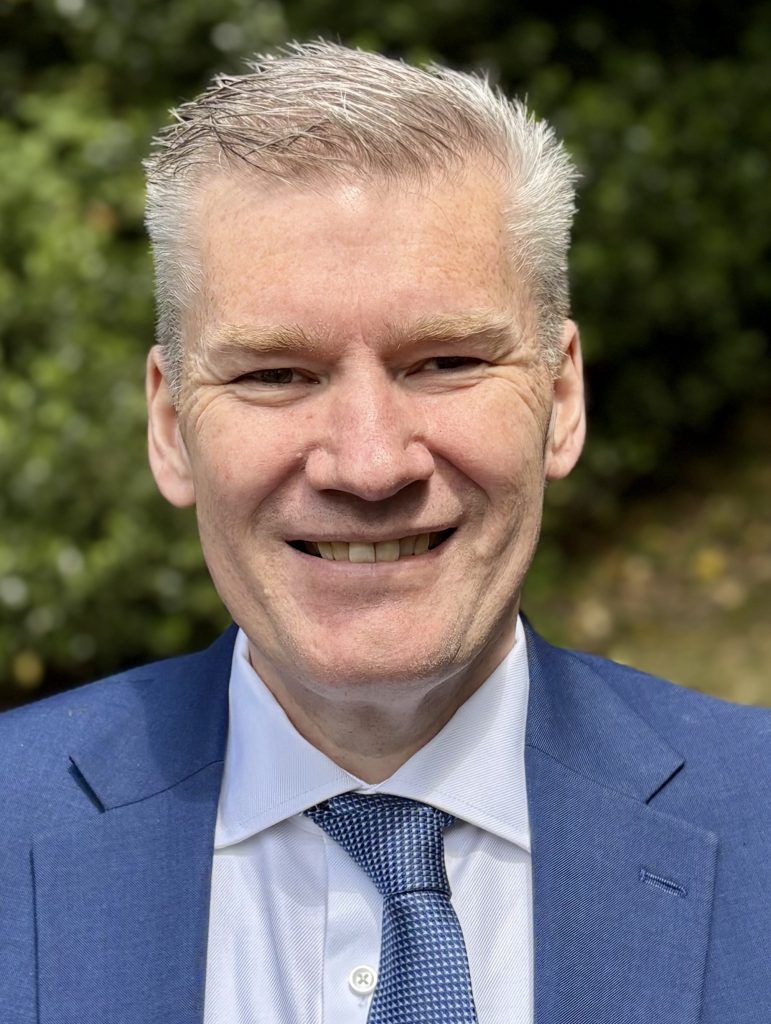
James D. Holt is an associate professor of religious education at the University of
Chester (England). This post is based on a presentation given at the ICLRS 32nd International Law and Religion Symposium, 7 October 2025.
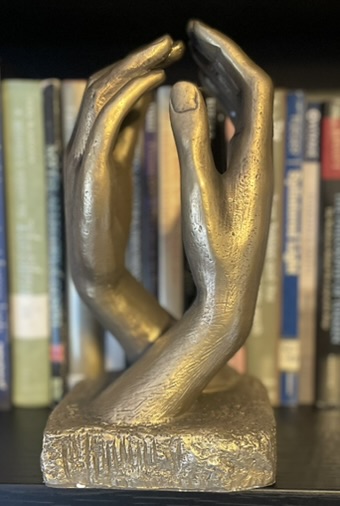
On my office shelves is a copy of the Rodin sculpture La Cathédrale, depicting two hands. I often begin presentations by asking people in the audience to try to recreate the image. What usually happens is that people try to do this by themselves but quickly find they can’t. In fact, it can’t be recreated without somebody else because it depicts two right hands. To me, the sculpture is symbolic of interfaith engagement—of the need for different, distinct entities to create engagement and relationship. But the sculpture also represents the relationship and engagement between education and freedom of religion or belief: You can’t have freedom of religion or belief without education, and you shouldn’t have education without freedom of religion or belief (FoRB).
Acknowledging Our Blind Spots
We are all familiar with FoRB violations being perpetrated around the world, for example, against the persecuted Yazidi community in northern Iraq or the Ahmadiyya community in Pakistan: The Yazidis have suffered genocide, displacement, and disappearance at the hands of the “Islamic State.” The Pakistan Constitution (Article 260) defines Ahmadis as “non-Muslim” or “posing” as Muslim. The Pakistan Penal Code (Ordinance XX, 1984) prohibits Ahmadis from identifying themselves as Muslim, offering Muslim prayers, publicly using Islamic titles or terms, or otherwise publicly practicing Islam or propagating their faith. Those who violate the ordinance risk a fine or imprisonment. Unfortunately, such cases of religious persecution are too familiar.
As chair of Freedom Declared Foundation I help promote freedom of religion or belief within the United Kingdom. The approach often taken in the UK is that we hope Britain is the gold standard when it comes to FoRB. In contrasting ourselves to other places around the world, we almost console ourselves:
“Well, we’re not like them.”
“We’re not doing that.”
“This isn’t happening in our country.”
But before we can talk about and try to support others, we need to get our own house in order; we need to ensure freedom of religion or belief is robust where we are. We can’t help others if we aren’t in a better position ourselves.
A handful of headlines illustrate issues that have arisen over the last five years in the United Kingdom: Islamaphobic and antisemitic incidents have both increased sharply since the 7 October 2023 attacks. A five-year-old Sikh boy’s hair was cut by another student at his public school. Catholic MP David Amess, murdered in 2021 for voting for airstrikes in Syria, was denied last rites at the scene. Muslim cricketer Azeem Rafiq testified before a parliamentary committee of the overt religious bigotry and harassment he has experienced from cricket fans. And football fans have been condemned for singing antisemitic songs both on and off the football pitch. Again, these headlines are merely illustrative of what we see within society and suggest we still have a way to go in protecting FoRB.
One challenge is that we sometimes think, “Well, legislation is in place; we’re fine.” But this blind spot can be problematic, as highlighted by social commentator Darren McGarvey, who recounts the poverty, addiction, and violence endemic in the Pollok housing estate in south Glasgow, in and around 1991. I was a Latter-day Saint missionary in Pollok in 1991 and had a very different experience—because I was in a position of privilege and power. This is important, as I might respond that because McGarvey’s experience wasn’t my experience, then it did not happen. If I do this, I fail to recognize that my position held privilege and that the experience of someone who feels on the margins is often very different. McGarvey suggests that, as a member of a deprived community, he was acted upon by the decisions of others, who may have been acting with the best of intentions but were doing so from an uninformed position, outside the community.[1] So we have to consider whether legislation is fully informed and doing what we intend it to do.
We can explore religious freedom from various angles: the institutions, the legal structures, the societal structures, and the individual responses. While laws might make certain requirements, are they enforced? Do our legislators support them? Do they even think about them? And do individuals think about and support them as well? Because support of freedom of religion or belief is incumbent on every member of society.
During the COVID-19 pandemic, a number of problems arose in the United Kingdom. The government tried to take on board the needs of religious communities but in doing so highlighted the existence of a two-tier system that favored Christianity above other religions. I suggest that is because those making decisions knew about certain forms of Christianity. One notable restriction was that singing was banned. If you attended church with me, that restriction would have been beneficial, because you really don’t want to hear me sing. But for Sikhs, Kirtan is a way to express worship and community; its significance wasn’t considered by those making decisions in Whitehall, and that is problematic. A similar concern hit closer to home as my daughter’s wedding was delayed. In conversation with elected politicians it became clear that they didn’t understand why she and her future husband couldn’t just move in together and get married later. Colin Bloom, faith engagement adviser to the UK government, proposed to define religion as belief in a supreme being or entity (or supreme beings or entities). That definition excludes Buddhism and other nontheistic religious traditions. The exclusion was likely not due to any malice; rather, policy advisers did not know about or consider different belief systems. That is where education comes in.
Religious Education: Promoting Knowledge, Understanding, and Freedom
I teach religious education. In UK schools, from the age of 4 to 18, every child attends an hour of religious education every week. It is not confessional in any way, shape, or form, nor is it aimed at promulgating a faith. Rather, the aims of religious education are to
- stimulate interest and enjoyment of religious education;
- prepare pupils to be informed, respectful members of society who celebrate diversity and strive to understand others;
- encourage students to develop knowledge of the beliefs and practices of religions and worldviews;
- encourage students to develop informed opinions and an awareness of the implications of religion and worldviews for the individual, the community, and the environment;
- give all students equal access to religious education and provide enjoyment and success; and
- develop pupils’ own responses to questions about the meaning and purpose of life.[2]
To have this deep impact, religious education must be more than a recitation of facts or information or, in colloquial terms, a pub quiz that asks students to name the five pillars of Islam, in the way we would ask who won the World Cup in 1966 (England, by the way). Knowing that the five pillars of Islam are Shahada, Salah, Zakah, Sawm, and Hajj doesn’t do or mean much by itself. We can all have knowledge, but what we do with that knowledge is the key.
I have written a series of books about the “big six” religions, in terms of adherents, within the UK—Buddhism, Christianity, Hinduism, Islam, Judaism, and Sikhism—as well as a book that explores religions outside the “big six.” These books are used by teachers and those training to be teachers in schools, emphasizing the lived reality of religion and the need for knowledge about religions so that stereotypes and misconceptions are not reinforced in the classroom. Knowledge and understanding of others are key.
Sometimes knowledge and understanding develop simply by breaking down barriers and engaging with one another. Emmanuel Levinas posited that if you meet and talk with someone face to face, you’re less likely to want to physically hurt them or even discriminate against them.[3] I once lived with an Irishman who hated Englishmen. By the time I left three months later, he hated one Englishman less. He still didn’t like Englishmen, but he had never really gotten to know one before. And so proximity and engagement are key. And when we teach and study world religions, we have to recognize that the space between us constitutes holy ground, a place of encounter and potential transformation.
Oftentimes individuals who are not familiar with the UK system are a bit disconcerted when they find out what I do for a living; they wonder how I, as a member of a particular faith, can teach about other religions. My response—and I’ve written extensively about this—is that I have learned more about my own faith through my engagement with other faiths.
Much of my work has focused on relationships with others and what I, as a member of The Church of Jesus Christ of Latter-day Saints, can learn from others. When I engage in interfaith relationship building, it’s not just to teach other people about what I believe. It’s to learn about what other people believe, take on board what they’ve said, and ask myself, “What can I learn from this?” I can learn much from the things we agree about and also, perhaps especially, the things we disagree about. One of the most significant things I’ve learned from Sikhi, for example, is the idea of Seva or selfless service. Although the idea of service is a principle of my own faith, when I reflect on Seva I realize that my service may sometimes have a transactional motive; I do something to get something back from someone else, or even to receive blessings from God. But for my Sikh friend, service is rendered with no thought of reward. Witnessing that example informs my own religious practices.
I taught for 15 years in secondary schools and have taught for the last 15 years at a university. Not long ago, I asked former students on Facebook to share what impact religious education (RE) has had on them. One former student shared,
One of the things [religious education] taught me most is about the power of debate. You can enter a debate with one opinion and leave it with a completely different one.
I wonder if our politicians understand that fact. I wonder if I understand that fact: when I have a dialogue, am I truly open to learning, or am I so consumed with getting my point across that I fail to listen and learn?
Others shared the following:
I learnt so many things I didn’t know, and it prepared me to live in a multi-faith society. . . . It helped me lots and when I’m at work I can easily connect with everyone from different faiths and beliefs.
I think learning about community and tolerance has had the biggest impact on my life. It’s something that crosses my mind every day.
Even though I’m a full-time mum now, what I learned through RE still shapes how I think and respond today. RE really prepared me for the world by giving me a broader understanding of people, cultures, and beliefs, which has been invaluable in everyday life. I’ll never forget the week visiting places of worship in Manchester[. I]t really showed the importance of taking time to understand different religions. I’ll always believe RE is such a crucial subject for young people, teaching respect, understanding and hope for peace.
I always wondered what the heck I would use that [information] for, but as I’ve gotten older and have been able to interact with more people, I’m so happy I [took the course]. I feel like there’s at least a starting point of understanding and basic respect for my fellow men. Now, I teach English to non-native speakers from around the world[;] I feel like it has helped me to relate well to my students, and I can use my basic understanding of their religion and culture to aid my teaching. We have meaningful, not-so-awkward conversations[,] or at the very least, I don’t offend them out of ignorance.
You’ve definitely helped in my professional life when we have been looking at building religious or cultural buildings too. I always ask the question around how behaviors will impact the schemes and/or effect our clients.
The final quote is from a former student who is now, I believe, a quantity surveyor. She, as a builder, considers the needs of others and facilitates freedom of religion or belief because of what she learned in our religious education class when she was 15 or 16 years old.
Conclusion
Education and freedom of belief are essential to one another. I’m grateful for the opportunity the UK’s religious education system gives us to learn about and from people of different religions, and, in doing so, to promote the freedom of religion or belief of all.
References:
[1] “[There is a ‘deficit’ we rarely talk about or acknowledge. . . . It’s the belief that the system is rigged against you and that all attempts to resist or challenge it are futile. That the decisions that affect your life are being taken by a bunch of other people somewhere else who are deliberately trying to conceal things from you. A belief that you are excluded from taking part in the conversation about your own life. This belief is deeply held by people in many communities and there is a very good reason for it: it’s true.” DARREN MCGARVEY, POVERTY SAFARI: UNDERSTANDING THE ANGER OF BRITIAN’S UNDERCLASS 37 (2018).
[2] JAMES D. HOLT, RELIGIOUS EDUCATION IN THE SECONDARY SCHOOL: AN INTRODUCTION TO TEACHING, LEARNING AND THE WORLD RELIGIONS, at ch. 1 (2d ed., Routledge 2022).
[3] See EMMANUEL LEVINAS, TOTALITY AND INFINITY: AN ESSAY ON EXTERIORITY 197–204 (Alphonso Lingas trans., Kluwer Academic Publishers 1991).